How a Hurricane-Induced, Month-Long Power Cut Let Light Inside
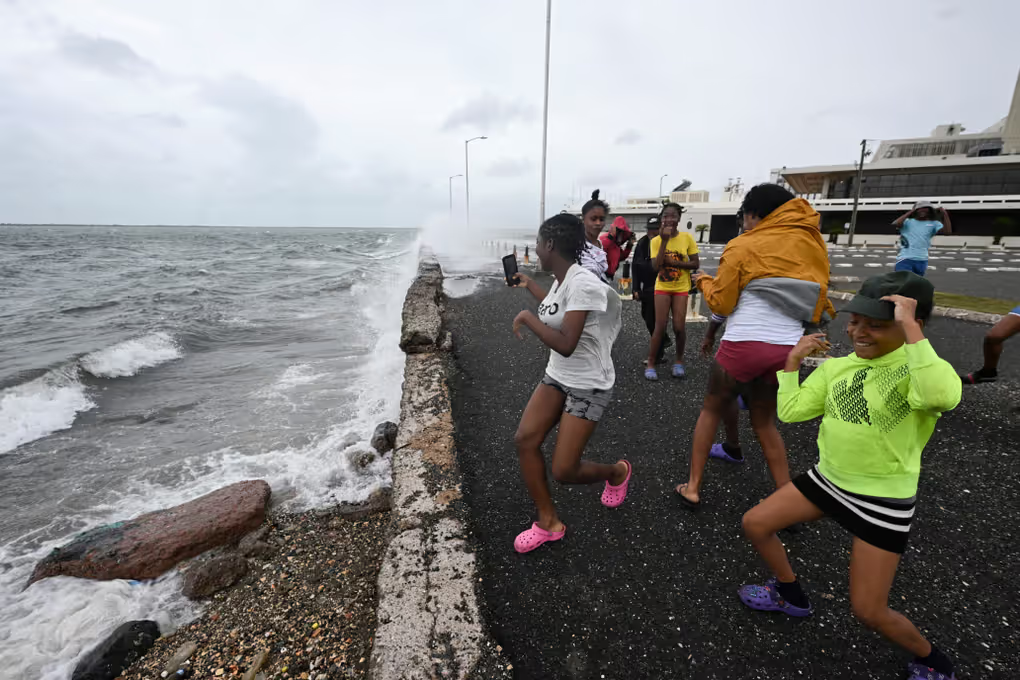
My eyes popped open at 6 a.m. Again.
There was no school run, or work commute. Just Day 19 of an extended power cut caused by the worst hurricane ever to hit the country. I lay still for a moment, as if I could will myself back to sleep, then gave up. I rise and set with the sun now.
That was the first surprise.
I had always believed I was a night owl. My best work came late, sharpened by the dark. But by week two without electricity, something in my body recalibrated. By 6 p.m., I felt the slow, undeniable pull of sleep. By 8, I was out. Morning, once anathema, became inevitable.
My family occupies a strange, under-discussed middle, not affluent or stable enough to own generators or solar systems, but not among the most vulnerable either. We had most of a roof, access to clean water and enough food to get by. Dubbed "the missing middle" in a UNDRR report, this in-between group makes up a significant share of disaster-affected populations, often without targeted support because they do not meet the threshold of immediate crisis.
That position shaped my experience. It was exhausting, sometimes frightening, often tedious, but it did not tip fully into crisis. We hovered at the edge of it, while many around us had already fallen in. And because we were not constantly in survival mode, there were unexpected, almost uncomfortable moments, when I could simply observe.
At first, the power cut was all inconvenience. Signal could be found only in a precise, almost mythical location - a two-by-two-inch patch somewhere in the yard where one device, if held just right, might catch a flicker of connectivity. Charging phones required someone to sit for hours beside an inverter rigged to a car battery to deter theft. Generator noise ranged from whisper soft to industrial racket coupling with the stifling, metallic scent of diesel. Information thinned. Boredom thickened.
Then, gradually, something shifted.
I was restlessly rested.
Without quite noticing when it began, I started sleeping better, not longer, necessarily, but deeper. Harvard Medical School’s Division of Sleep Medicine points out that reduced exposure to the blue light emitted by screens can significantly improve sleep quality by allowing melatonin production to follow its natural cycle.
A 2015 study published in Current Biology discovered that natural temperature shifts play a role in regulating sleep cycles, an influence often muted by modern conveniences like climate control and artificial lighting.
Accounting for stress, something about the enforced darkness seemed to restore something I hadn’t realised I’d lost. The adjustment was not perfect. I still woke, inexplicably, at 3 a.m. most nights. Maybe I’m hot, maybe I’m traumatised.
Without connection, we connected more.
Without Wi-Fi or reliable mobile data, the usual private escapes disappeared. The evenings stretched out and suddenly, our neighbours emerged. A last minute attempt to save perishable food turned into a neighbourhood potluck, then games nights, then just shooting the breeze to share space with people who understand what we were going through.
Sociologist Daniel Aldrich, whose work focuses on community resilience, found that shared adversity can strengthen communal bonds, increasing cooperation and face-to-face interaction, particularly when usual technological mediators are removed. It sounds romantic when written down but In reality, it was uneven, sometimes strained, but became a necessity to cope.
Stream of information stopped, so I was more informed.
Cut off from the constant churn of online updates, I initially assumed I knew less. But what replaced it was information grounded in reality. News came from people who had clawed their way out of mud-soaked homes, who had braced their doors in the strongest winds, who had fled to bathrooms when their roofs peeled back like sardine tins. I witnessed the blank-eyed stare of loss and displacement.
Pew Research Center showed that large-scale media coverage often compresses events into broad narratives, emphasising scope and scale. Firsthand accounts, by contrast, tend to preserve texture, such as the sequence of moments and the physical reality of what something felt like as it unfolded.
Aerial footage showed widespread heartbreaking destruction but left the suffering abstract. Hearing the voice full of fear, seeing the tears and holding the hands of someone who has lost everything makes it real.
Movement increased, though not by intention.
The house, without power, held heat in a way that made staying still difficult. We walked to find air, to find people, to find something to do, not to track steps or close rings. Tasks that would once have been minor became physical like carrying water, adjusting makeshift systems, moving between places instead of sending messages.
The World Health Organization recognised this, stating that periods of reduced screen use and increased necessity-based activity can lead to higher levels of incidental physical movement, even in constrained environments.
At night, the sky changed.
With much of the grid down, light pollution receded. The darkness was deeper than I remembered, and within it, the stars returned sharp and numerous, almost intrusive in their clarity. Astronomers have long warned that artificial lighting obscures the night sky for most of the world’s population; in its absence, even urban areas can briefly recover a view that feels both ancient and unfamiliar.
There were internal adjustments too.
Fewer distractions and fewer places to direct attention meant thought itself altered. There was more space for it, and more need to manage it. Dwelling too long on uncertainty, on what might happen if the power did not return, if supplies ran out, if conditions worsened, became its own burden. So attention turned, sometimes deliberately, toward what remained. The American Psychological Association describe this as adaptive coping - finding ways to reframe or focus attention in order to manage stress when circumstances cannot be changed.
It is not optimism, exactly, but more maintenance.
But none of this cancels the costs.
Darkness provided cover for crime. Generators contributed to air and noise pollution. Food spoiled and medicines became harder to store safely. For many, especially those already vulnerable, the absence of power was not an inconvenience layered with unexpected insights but a direct threat to health and security.
But for those positioned, however precariously, to withstand it, the experience offered something else as well: a glimpse of how quickly the scaffolding of modern life can fall away and how the body, the mind and the social world rearrange themselves in response.
By Day 19, waking at 6 a.m. was an anchor.